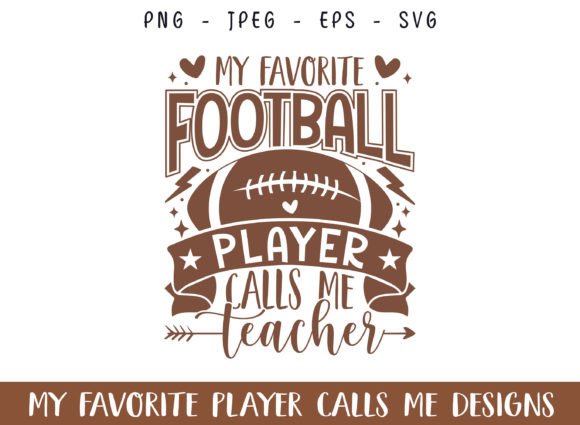
Favorite Football Player Call Me Teacher Review
As a professional embroidery digitizer and product reviewer, I approach every new graphic with a specific question: will this actually stitch out cleanly on fabric? When evaluating the Favorite Football Player Call Me Teacher design, my assessment goes beyond the cute concept. While the product description highlights its versatility as an SVG for mugs and t-shirts, my focus is strictly on its viability as a machine embroidery design for commercial and personal projects. This review breaks down how this vector-based artwork translates into thread, where it shines in a craft business setting, and the technical precautions necessary for a professional finished product.
First Impressions: Vector Clarity Meets Stitch Reality
The initial appeal of Favorite Football Player Call Me Teacher lies in its dual audience targeting. It bridges the gap between sports enthusiasm and educational pride, making it an ideal candidate for teacher appreciation gifts or back-to-school spirit wear. Because the source file is listed as "100 vector," this is a significant advantage for embroidery digitizing. Vectors provide clean, mathematical lines rather than pixelated edges, which means the auto-digitizing process or manual tracing will result in smoother satin stitches and more precise running stitch outlines.
Visually, the layout suggests a balanced composition. For an embroidery project, balance is critical. A top-heavy football helmet paired with small text at the bottom can cause hoop drag or registration issues. However, this design appears to integrate the typography and iconography cohesively. The mood is playful yet structured, avoiding overly intricate shading that often gets lost in translation from screen to fabric. As a graphics asset, it feels modern, but as a potential embroidered patch or chest logo, it respects the limitations of thread density.
Real-World Application: The Custom Sweatshirt Test
To truly judge this design, I mentally placed it in a real-life production scenario: creating a custom crewneck sweatshirt for a high school teacher who coaches football. This is a classic use case for Etsy sellers and small shop owners during the fall season. Sweatshirts are thicker, stable fabrics that generally handle embroidery well, but they also demand high-quality digitizing to prevent puckering.
In this scenario, Favorite Football Player Call Me Teacher serves as a centerpiece. If using this as a sweatshirt embroidery design, I would recommend placing it on the left chest or centered at 4x4 inches. The vector nature allows for easy resizing without losing edge definition, which is crucial when adapting a digital embroidery file for different garment sizes. For a tote bag design, the same file could be scaled up to 6x6 inches to fill the canvas space. The key here is that the design’s simplicity allows it to transition between apparel and accessories without requiring a complete re-digitization, saving time for busy makers.
Navigating Fabric Textures and Stabilizer Choices
While the design is versatile, material selection dictates success. If you are applying this to a textured terry cloth towel or a ribbed knit baby item, the fine details in the football laces or script font may get swallowed by the fabric texture. In these cases, using a water-soluble topping stabilizer is non-negotiable to keep the stitches sitting on top of the pile.
For stretchy performance fabrics or thin jersey knits, the risk of distortion increases. Even though the artwork is clean, the physical pull of satin stitches can warp the garment. I always advise testing on scrap fabric first. Use a cut-away stabilizer for stretchy materials to maintain the integrity of the Favorite Football Player Call Me Teacher shape after washing. If the design includes large fill stitch areas, ensure your stitch density isn't too high, or the fabric will become bulletproof and stiff. Conversely, if the density is too low, the fabric grain will show through, making the handmade product look unprofessional.
Color Adaptation for Light and Dark Garments
The product notes mention an "easy change color for dark or white t-shirt," which is a vital feature for commercial embroidery. However, changing colors in software is different than managing thread changes on a machine. For white shirts, standard team colors work beautifully. For dark garments, simply changing the fill color isn't enough; you must consider contrast and underlay.
If stitching this onto a navy or black sweatshirt, light-colored thread is mandatory for visibility. More importantly, you may need to add a white underlay base beneath colored elements to prevent the dark fabric from bleeding through lighter threads. This adds stitch count but ensures the vibrant, professional look customers expect. Always run a black-and-white mockup or a physical test stitch to verify that the contrast ratios hold up before listing the item in your Etsy shop or boutique.
Technical Considerations for Small Details and Hoop Sizes
One area requiring caution is small lettering. If Favorite Football Player Call Me Teacher includes tiny taglines or player numbers, these can become illegible when scaled down for baby embroidery or cap designs. Satin stitches below 1mm width often break needles or create tension issues. Before committing to a small hoop size, inspect the minimum text height. If the letters are too small, consider removing secondary text and keeping only the main graphic and primary phrase.
Curved surfaces like caps present another challenge. Flat vector art doesn't naturally wrap around a curved brim. If adapting this for hat embroidery, you may need to manually adjust the push/pull compensation in your digitizing software to account for the curve. Additionally, verify your hoop size compatibility. Just because a design fits in a 4x4 hoop digitally doesn't mean it leaves enough clearance for the presser foot. Always measure the actual stitch field with a safety margin.
Commercial Viability and Professional Presentation
For creative entrepreneurs, the value of this design extends beyond a single project. It is a strong asset for holiday embroidery collections, specifically for teacher gifts and football season merchandise. The "Call Me Teacher" sentiment adds emotional value, increasing the perceived worth of the finished product compared to generic sports clipart.
When marketing this as a personalized gift, presentation matters. Use printable mockups to showcase how the design looks on various products, but always include a photo of a real stitched sample. Customers trust what they can see in thread form. Highlighting that the design is optimized for both light and dark fabrics demonstrates professional expertise. Furthermore, confirm the licensing terms included with the digital embroidery file. Ensure you have the rights to sell finished physical products versus selling the digital file itself, as these licenses often differ.
Designer Checklist for Success
Before running Favorite Football Player Call Me Teacher on a client order or inventory piece, run through this practical checklist:
- Test Stitch: Never skip the sample run on the exact fabric and stabilizer combination you plan to use.
- Contrast Check: Verify thread colors against both light and dark backgrounds to ensure readability.
- Density Review: Inspect fill stitch areas to ensure they aren't too dense for the chosen fabric weight.
- Size Verification: Confirm the design fits your hoop with adequate clearance and that text remains legible at the intended size.
- Licensing Audit: Double-check commercial use rights for both physical sales and digital distribution.
- Stabilizer Match: Select tear-away, cut-away, or wash-away based on fabric stretch and texture, not just convenience.
Ultimately, Favorite Football Player Call Me Teacher is a promising candidate for the embroidery market. Its vector foundation provides a solid starting point for clean digitizing, and its thematic relevance targets a passionate niche. By respecting the technical realities of stitch physics, fabric behavior, and color management, makers can transform this digital graphic into a high-quality, profitable handmade product that resonates with teachers and football fans alike.