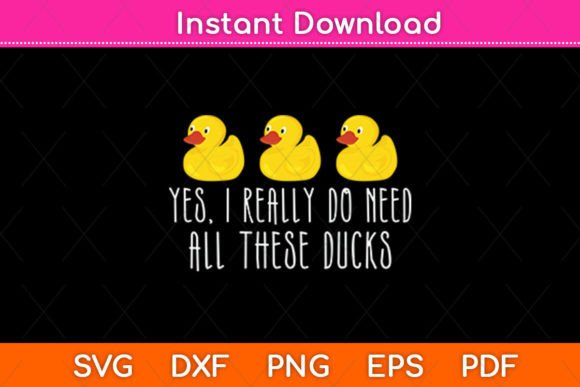
Yes I Really Do Need All These Ducks Svg Review
As a designer who bridges the gap between digital graphics and physical embroidery, I approach every new file with a specific question: will this actually stitch out well, or is it just a pretty screen image? When I first opened Yes I Really Do Need All These Ducks Svg, my immediate reaction was a smile. It captures that specific, chaotic joy of waterfowl obsession perfectly. However, as an experienced reviewer evaluating this for real-world application, my next thought was purely technical. This design sits at the intersection of humor and utility, making it a prime candidate for specific Crafts projects, but it requires thoughtful execution to translate from a vector graphic into a high-quality embroidered product.
First Impressions and Visual Personality
The mood of this design is undeniably whimsical yet relatable. For those of us in the maker community, the phrase "Yes I really do need all these ducks" is practically a mantra. Visually, the layout suggests a playful arrangement that feels organic rather than rigid. As a Graphics asset intended for cutting machines like Cricut or Silhouette, the lines are likely clean and optimized for vinyl. But for us embroidery professionals, we have to mentally convert those vectors into thread paths.
The personality here is lighthearted and conversational. It does not feel stiff or overly formal, which dictates where it belongs. This is not a design for corporate branding or solemn occasions. Instead, it naturally fits into the realm of personalized gifts, hobbyist gear, and boutique merchandise that celebrates niche passions. The visual weight appears balanced enough to serve as a standalone statement on a tote bag or sweatshirt without needing excessive embellishment.
Real-World Application: The Canvas Tote Test
To truly evaluate this design, I mentally placed it on a heavy-duty canvas tote bag, a staple item for many Etsy sellers and craft business owners. Imagine preparing a custom order for a client who raises ducks or simply adores them. A tote bag offers a stable, woven fabric texture that is generally forgiving for machine embroidery designs.
In this scenario, Yes I Really Do Need All These Ducks Svg would likely perform best as a combination of applique and text. If the duck illustrations are solid shapes, converting them to an applique design saves thousands of stitches and prevents the dreaded "bulletproof" embroidery effect where dense fill stitch makes the bag stiff and heavy. The text portion, presumably the witty slogan, would benefit from a clean satin stitch or a textured fill stitch depending on the font style. On a natural canvas background, using dark green or navy thread colors would provide excellent contrast and readability. The result is a functional, handmade product that feels professional rather than homemade, increasing customer trust and perceived value.
Navigating Fabric Choices and Stabilizer Needs
While canvas is ideal, many makers will want to use this design on apparel. Here is where practical judgment is crucial. Sweatshirt embroidery is a massive market, especially for holiday gifts and winter wear. Fleece and french terry fabrics have loft and stretch. If you run this design directly onto a sweatshirt without proper stabilization, the registration could shift, causing gaps between the duck elements and the lettering.
I strongly advise using a cut-away stabilizer for any stretchy knit fabric when stitching this design. For lighter fabrics like baby clothes or tea towels, you must be cautious about stitch density. If the original SVG has thick lines meant for vinyl, digitizing them as dense satin stitches might pucker delicate cotton. In those cases, consider a running stitch outline or a lighter fill stitch to maintain the drape of the garment. Always check your hoop size before committing; ensure the design fits comfortably within your machine’s field without requiring re-hooping, which introduces alignment risks.
Commercial Viability for Small Business Owners
For Etsy sellers and small shop owners, time is money. Yes I Really Do Need All These Ducks Svg has strong commercial potential because it targets a passionate niche. Duck enthusiasts are loyal buyers. However, product value depends entirely on execution. A sloppy stitch-out devalues the brand, while a crisp, well-digitized version elevates it.
If you are selling finished products, test the design on scrap fabric first. Verify that the smallest details—like the eyes on the ducks or the serifs on the letters—are legible. Tiny details often get lost in embroidery translation. If they are too small, edit the digital embroidery file to simplify them before production. For those selling digital assets or printable mockups, ensure your preview images accurately represent how thread behaves versus ink. Customers appreciate honesty in presentation. Confirm your licensing terms explicitly; just because a file is an instant download for cutting machines does not automatically grant unlimited commercial embroidery rights. Protect your business by verifying usage permissions before listing items for sale.
Technical Considerations and Designer Notes
Transitioning from an SVG meant for cutting machines to an embroidery project requires diligence. Here are my practical notes for anyone planning to use this design:
- Verify File Compatibility: Since the product description highlights cutting machine compatibility, confirm you have the correct embroidery file format (PES, DST, JEF, etc.) for your specific machine before purchasing or downloading.
- Test Stitch Density: Run a test sew-out on the exact fabric you intend to use. Adjust pull compensation if the fabric is stretching or puckering.
- Thread Color Contrast: Test black and white mockups digitally, but also physically stitch on both light and dark backgrounds. Some details visible in vector software disappear when stitched in low-contrast thread.
- Stabilizer Selection: Match stabilizer weight to fabric weight. Use tear-away for stable wovens and cut-away for knits. Consider a water-soluble topping for textured fabrics like fleece to prevent stitches from sinking in.
- Detail Inspection: Zoom in on the digitized file. Ensure no stitch columns are thinner than 0.8mm to avoid needle breaks or thread shredding.
- Wash Testing: If creating tea towels or baby items, wash and dry the test piece. Durability is key for customer satisfaction in the handmade market.
Elevating the Finished Product
Ultimately, Yes I Really Do Need All These Ducks Svg is more than just a cute graphic; it is a vehicle for connection. Whether you are creating a personalized gift for a fellow bird lover, stocking your boutique with unique apparel, or expanding your digital design assets library, success lies in the details. By treating this SVG as a starting point for thoughtful embroidery adaptation rather than a final destination, you ensure the finished product honors both the humor of the design and the quality of your craftsmanship.
Remember that in the world of commercial embroidery and creative entrepreneurship, your reputation is stitched into every item you sell. Take the extra hour to test, adjust, and refine. When the design is executed with precision, it transforms from a simple digital file into a cherished keepsake that customers are proud to display. That is the true measure of a successful embroidery project.